Tag Archives: religion

B’har

Advocates of modern political and economic positions often look to the Bible for religious support — as if revelation some thousands of years ago should have anticipated the dilemmas of every age to come. This week’s portion, with its compelling laws of ownership, have therefore been mined by liberals and conservatives alike to defend their views.

Ardent socialists, for example, have cheered the idea of declaring every fiftieth (or Jubilee) year a time when land devolves upon the original owners, thereby prohibiting large landed interests from owning real estate in perpetuity. Equally ardent capitalists note the high value placed on private ownership in the first place. The Bible itself measures land value against the number of harvests to be realized before the Jubilee, thus recognizing due market value to guide investors. Land purchased in the first year of a fifty-year cycle is worth more than the same land purchased, say, just ten years before that cycle’s end.

To all of this, the modern collector of commentaries, Yehudah Nachshoni, reminds us that both socialism or capitalism are “concepts derived from modernity.” Readers can find support for both throughout the Torah, which, after all, was given long before Adam Smith or Karl Marx.

Not that Torah is irrelevant to modern concerns; but what it provides is a spiritual framework, not an economic one. Maimonides rightly observes (in his Guide, 3:38) that the laws of sabbatical and Jubilee years were given “to imply sympathy with our fellow human beings and to promote the wellbeing of humanity.”

Its essential claim is that all property — land first and foremost in an agrarian economy — belongs to God. By extension, we, the owners, also belong to God. Neither land nor people can be ravaged for personal gain.

To be sure, ecological concerns are inherent in laws that prevent abuse of land; the land is God’s after all, not ours, in the long run. But overall, the Torah’s concerns here are with issues of people, who are, as it were, tenants gifted with stewardship over goods that predated our coming into the world and will be here long after we die.

In biblical times, ownership of at least some plot of land was crucial, so the Torah makes each of us a landholder. We may sell our land if absolutely necessary, but not all of it — at least some residue of property must be retained lest the owner become completely destitute and become indentured to some other person.

In reality, indentured servitude did occur, of course — Torah’s regulations here are ideals, after all, and as such, were as subject to economic conditions as we are. So rabbinic regulation turned to conditions of indenture, as a consequence of the spiritual principle that we too belong to God — no less than the land does.

If we sell ourselves, in effect, as a matter of economic survival, our masters must recognize that they now have mere stewardship over us, until such time as we can revert to our original master, God. The entire Jewish story begins with the proclamation that God redeemed us from Egyptian slavery and says, “You are my servants” — not (say the rabbis) so that you should become “servants to other servants.” We may indeed, therefore, acquire masters for ourselves in respect to any manner of work, but insofar as we are God’s servants, “we have no power to sell ourselves into absolute servitude.”

Most obviously, our new masters may not make total serfs of us, subjugating us through hard labor — farekh, in Hebrew, the same word used to describe the work that taskmasters assigned the Israelites in Egypt. But the Rabbis apply it to even the smallest details — like asking servants to do unnecessary work just to keep them busy. We also may not give our workers assignments with no end in sight, like doing field work “until I return,” since the worker has no idea when that will be.

These rules, moreover, apply not just to Jews. The Torah has no modern concepts as clear cut as absolute particularism versus universalism; it had no concept of social rules that might apply to people completely beyond the reach of Jewish governmental structures. But it takes a universal turn when it applies these rules of common decency to everyone within the jurisdiction of Jews: not just Jews but resident aliens as well.

The Torah even worries about the spiritual condition of the master. Modern Orthodox master Isaac Breuer lived at the height of rampant capitalism and worried about the wealthy who deny that God owns everything and even live as if they too do not own everything because what they own actually owns them!

More important than the precise examples is the principle: the earth is God’s; all creation is God’s; we are part of creation; we are God’s as well. And in God’s scheme, we are all intended to get beyond Egyptian servitude so that regardless of economic conditions, we may not be reduced to have lives of indignity.
Tazri’a-M’tsora

Medically speaking, the biblical disease that is usually translated as “leprosy” (tsara’at) has nothing to do with slander (motsi shem ra). But our pre-scientific rabbinic ancestors connected the two as if they did. Tsara’at for them was like advanced and untreatable cancer for us. They deliberately associated the gravest threat to bodily health with character damage caused by the misuse of language, as if to say they were equivalent.

That decision should take our breath away. Our culture cares relatively little about damage we do through verbal abuse. Beyond taking adequate care to avoid lawsuits, we engage rather freely in speaking loosely of others.

Jewish law, by contrast, is nothing short of obsessive on the subject. It delineates three kinds of verbal abuse and insists that we cease and desist from each and every one: 1. We are forbidden to invent or pass on lies about people (motsi shem ra). 2. We may not even speak negatively about them regarding things that happen to be true (lashon hara)! 3. And even idle gossip (r’chilut) is forbidden, since gossip thrives on the objectionable, if not the downright sordid.

Clear distinctions among the three categories emerge only in the Middle Ages, where, for instance, the two great legalists Maimonides and Nachmanides argue whether lashon hara is its own classification or just a particularly heinous case of r’chilut. Until then, rabbinic writing frequently lumps them all together as just plain scurrilous talk, which insidiously eats away at a person’s good name and thereby causes injury. The Talmud goes so far as to say that “speaking lashon hara is like denying the existence of God.”

This, mind you, is for lashon hara — speaking evil of others, even if the charges are true! Why is even this lesser offense equivalent to, of all things, apostasy — pretty much the worst crime against God that the Jewish imagination can muster?

Our commentators are of no single opinion on the subject. One prominent example (attributed to Maimonides himself, among others) provides the slippery slope scenario. If we get used to speaking negatively about our own ordinary friends and acquaintances, it is only a matter of time until we do so even of people in authority, including those whose wisdom and way of life testify of God’s existence. We would thereby end up implicitly casting doubt on the most obvious human exemplars of God’s reality.

A better answer, I think, comes from a teaching attributed to the Chafetz Chaim, who is said to have cautioned against speaking lashon hara even of oneself. Discussion of lashon hara usually assumes that the prohibition is rooted in the damage that it causes. But what damage do we cause ourselves by owning up to our own negative character traits? Doesn’t Judaism demand we do just that? We call it t’shuvah (“repentance”)!

The Chafetz Chaim is, no doubt, thinking of people who go beyond proper <i.t'shuvah — people, that is, who habitually run themselves down. It is this constant negativity toward oneself that is forbidden — because being overly self-critical is a slight on God, the Creator who made us.

At stake is what we call religious anthropology, our doctrine of human nature. Judaism insists on seeing something divine in each and every one of us. In 1994, a singing group, “The Halo Benders,” released an album entitled, “God Don’t Make No Junk” — a title that has inspired hundreds of T-shirts, bumper stickers, web-site postings, and other forms of subtle protest against a society that teaches us that we are, overall, wanting.

We can understand the Chafetz Chaim as emphasizing the much earlier and specifically Jewish version of “God don’t make no junk.” It’s one thing to take honest stock of who we are; it’s quite another to run ourselves down all the time (even if the charges are mostly true) without simultaneously appreciating what is good, decent and even godly within us. The self-directed lashon hara of speaking overly negatively about ourselves ignores the reality of God that forms the essence of every living soul.

The implicit denial of God’s presence in any human being, even ourselves, is indeed the subtlest of apostasies. And it is a sin.

Parashat Mishpatim

Twice this week, we encounter Israel’s famous acceptance of responsibility at Sinai. The people first say, simply, “Whatever God says, we will do” (Exodus 24:3). Just a few lines later (24:7), they say, “Whatever God says, we will do and we will hear.”

Tradition has made much of these affirmations. For starters, they have been applied to two different moments in time: the first followed God’s demand that Israel prepare for revelation; the second refers to revelation itself.

Then too, the order of the verbs — first “we will do” and only then, “we will hear” — has attracted enormous commentary. Most interpreters have deduced the lesson that proper comprehension of God’s will flows only from the prior performance of it, not the other way around: that is, we do not first hear and then do; we do and only then do we hear.

But how could that be? “Something” had to have been heard to prompt the doing. The answer must be that, existentially speaking, what we hear at first is only a vague demand for action that must be tried out before we really understand it; in that sense, “we will do” really does come first; only out of doing, do we more fully grasp what was meant by the first hearing. Only then can we revisit the original hearing and rehear it for all that it entails.

Now we understand a lesser-noted difference — in the first promise, “Israel answered in a single voice.” Not so the second time. There, the unanimity of voice is missing. They had no trouble agreeing with one voice that they would prepare for the covenant. But they were of more than a single opinion as to what that covenant entailed, since they knew that it would mean different things for each of them, and only after trying it, would each person know what it might mean personally.

The idea that we try out what we think God wants runs counter to the usual understanding of religion, which, we assume, is black or white, totally objective, clear and distinct from the outset. Nowhere else do we suffer from this childlike delusion. Congress makes rules but then changes them, as exigency demands. Even the Supreme Court changes its mind on what exactly we mean, by, say, “cruel and unusual punishment.”

Sure, we promise enduring love to the ones we marry — but the naivete of courting gives way to the experience of actual marriage, when we understand better what true love demands. Yes, we pledge allegiance to the flag — but then we alter the kind of America for which we believe the flag must stand: the “manifest destiny” of the days when Americans thought the entire continent belonged to them is long gone; our inalienable right to life, liberty and the pursuit of happiness means different things in different eras.

Why should this ever-changing landscape of understanding not apply also to religion? Israel could speak with one united voice when the only thing at stake was preparing to receive the covenant. The covenant’s exact terms, however, were another matter. Everyone agreed to commit to it, but they knew that the “it” in question would change, as experience kept revising the understanding of what God had asked for.

Religion gets short shrift in America today because the idea of utter changelessness is blatantly childish. Until we treat religion as a fully adult thing, we can expect religious loyalty to falter. The only way forward is to reassert what Torah here implies: we Jews do agree to do what God wants; but not with a single voice, because we know our understanding must change with personal experience. We hear things differently as we age through life. And God, who made us, knows that very well.

Parashat Bo

There is something magic about midnight, as any child who has read “Cinderella” can tell you. It is the witching hour when imagination fails, when radiance turns into pumpkins, when dreams die fast.

Edgar Allen Poe expresses this resonance of despair in his poem, “The Raven,” the tale of a man whose yearning for his lost love Lenore is dashed by a “ghastly grim and ancient raven” who inserts his way into his home “once upon a midnight dreary” with the one-word prophecy, “Nevermore.” Never mind this life; there is also no life after death, no heavenly bliss where the two lovers may someday find one another again. “Is there no balm in Gilead?” asks the man, citing Jeremiah 8:22, no hope whatever? The raven’s answer comes unhesitatingly: “Nevermore.”

Poe’s midnight message chills us to the bone. We have all awakened in the dark and deep of night and thought for sure the nightmares that disturb our sleep are real, that “nevermore” will we find hope, love, health or joy; that a new day will never dawn.

It is around midnight too when the ghost of Hamlet’s murdered father appears; and when Washington Irving’s Headless Horseman visits horror upon unwitting travelers. Nothing good can happen in what we call “the dead of night.”

How interesting, then, to find this week that God chooses “around midnight” for the angel of death to slay Egypt’s first born. From Israel’s perspective, however, this is deliverance, so ever after, Jewish lore associates midnight with good things happening. A traditional Haggadah poem carries the refrain, “It happened about midnight.” At midnight Jacob wrestled with the angel; at midnight Daniel was saved from the lion’s den. Baal Haturim concludes, “The Holy One performs miracles for the righteous — at midnight.”

Christianity too adopted this positive view of midnight. Since God had saved the Israelites then, the New Testament pictured prisoners breaking free from a Roman jail on account of the midnight prayers of Paul and Silas (Acts 16:2); and in 1849, Unitarian minister Edmund Sears wrote the Christmas carol, “It came upon the midnight clear.”

A novel touch arrived with the spread of coffee throughout the Mediterranean in the sixteenth century. With Jews newly wired by heavy doses of Turkish coffee, kabbalistic masters converted midnight hope into ritual, alongside the promise that midnight was especially apt to find God’s presence among us. Mystical adepts would arise at midnight for a tikkun chatsot, a set of readings intended to bringing about a better world.

But kabbalists were building on more ancient lore: Psalm 119:62, which had King David say, “I arise at midnight to thank You.”

Chanukah, Thanksgiving, and War

As I sat down to write this, it was Thanksgiving in America, and Chanukah was on its way; but the big news was the uneasy truce just announced in Israel. While the rest of New York watched the Thanksgiving Day Parade, therefore, my thoughts turned to this latest round of war and to Chanukah, which commemorates yet another failed attempt to destroy us.

The war that gave us Chanukah was described in I and II Maccabees, whence we get the heroic tales of Judah and his brothers, a priestly family called Hasmoneans. Like all wars, that one too claimed innocent victims in abundance, but eventually, the Hasmonean army prevailed and went on to establish only the second Jewish commonwealth in a thousand years (the first had been the kingdom of David and his descendants).

Not all wars end that well, however, so even though I am not one to overstate the victimhood of Jews – the lachrymose theory of Jewish history, as historian Salo Baron named it — something moved me, as I left for the airport, to take along Yeven M’tsulah, Nathan of Hannover’s chronicle of the 1648 slaughter of Ukrainian Jews by Cossack leader Bogdan Chmielnicki. This was no “Happy Chanukah” tale in the end! We had no Jewish army at all; the Chmielnicki massacres left their mark for centuries as the Shoah of their time.

“I’ve recorded it,” Nathan explains, “so that people can compute the day of their parents’ death and be able to mourn them appropriately.” That’s the best he can offer: proper mourning.

Today’s war in Gaza should be viewed against the backdrop of these two existential bookends: Chmielnicki on one hand and Chanukah on the other. With Chmielnicki, we were helpless; with Chanukah, we were not. Herzl founded Zionism so that we might put Chmielnicki behind us. He even envisioned the Jews of his Jewish State becoming “a new breed of Maccabee.” They would direct just the third Jewish commonwealth of all time.

War is war. All wars randomly maim and erase lives; and all wars are political; there is nothing pure about them. The Hasmoneans were embroiled in internecine civil war as well, one priestly family against another. The Hasmonean chroniclers paint the anti-war party as selfish collaborators and assimilationist idolaters, but they were really just good men and women who saw things differently. The problem is, you never know until after wars are over how they will turn out, so good people are properly divided on whether a war should happen; and if so, with what force, for what duration, and to what end.

This time, in Gaza, war was necessary, it seems, given Hamas intransigence against a Jewish state and the stockpile of fire power raining down on Jewish settlements. Thank God this looks more like Chanukah than Chmielnicki. Most Americans did not give thanks on this Thanksgiving Day for being spared a holocaust. Perhaps at least some Jews did. We have, I hope, put well behind us the day when enemies could slaughter us at will.

I now read Yeven M’tsulah as a historical memory of the way things used to be. I read I and II Maccabees as the way they are again: Jewish power to prevail against forces larger than our own; but also the terrible fact that we are still threatened by those forces, and the stunning reality of what war does in crippling, maiming, burning, and slaughtering, all around.

There is yet another way that we have left the world of Nathan of Hannover behind us. Nathan comforted Chmielnicki’s Jewish victims by assuring them that God somehow desired their martyrdom al kiddush hashem, “for the sanctification of God’s name” — an idea that goes back to the Maccabean era, took root after the wars against Rome, and flourished especially in the Middle Ages when Jews were powerless to protect themselves. With Chanukah too, we chose officially to recall God’s role: the miracle of oil when the war was over, and the conviction that God fought on our side, giving us victory over a power much greater than ourselves. Long before Adam Smith usurped the term to explain the economy, the invisible hand of history was held to be God.

Nowadays, we quite properly believe that God has no hand at all in the wars we fight. We are on our own, having to rally political support, explain our position to the world, build Israel’s military capacity, and then agonize over when and how to use it. Small comfort, that. But it’s better than writing another Yeven M’tsulah with nothing to offer beyond the proper dates for remembering our dead.

God is Good; Nature is Neutral; Yadda Yadda Yadda: Let’s Move On

Having just edited a book called We Have Sinned (Jewish Lights, 2012), I was interviewed last week on NPR’s “Talk of the Nation,” part of an interfaith dialogue on sin and repentance. I was struck by a segment in the show which raised the issue of God’s love. In response to a question from the host, Neal Conan, the imam assured us that Allah is merciful. The Roman Catholic priest concurred: Christians too view God as merciful. I then cited Rabbi Akiba’s guarantee, “Happy are you O Israel, for God loves you; happier still are you because you know God loves you.” As I finished, I wondered: Why this fetish with staking out claims on God’s love?

Well, for one thing, a lot of people have apparently been raised believing the opposite: a lot of clerics have spent a lot of time describing God as a pretty harsh judge. For another, religious leaders who represent this eternal God of love are often the worst spewers of violence and venom. And finally, the universe that God is supposed to manage can seem downright cruel: the world of hurricanes, droughts and tsunamis is not exactly a loving place.

Each of these difficulties deserves an answer.

1. I regret the miserable systems of religious education that have somehow managed to miss the point. Old-world religion did indeed emphasize sin and punishment more than love and pardon, but those are bygone days, and religion today is no more responsible for them than modern science is for medieval alchemy.

2. Religion’s oppressiveness comes from fundamentalists who use religious certitude for their own selfish ends. The issue, however, is not religion; it is power. Religions, nation states, individual demagogues, and corporations are alike in causing willful damage whenever they get too much power. Religious hate-mongers do abound, but so too do evil CEOs and government officials, and we should no more get rid of religion than we should business and democracy.

3. Way back in 1874, John Stuart Mill set us right about nature, saying, “It impales men, breaks them as if on the wheel, casts them to be devoured by wild beasts, burns them to death, crushes them with stones… starves them with hunger, freezes them with cold, poisons them by the quick or slow venom of her exhalations, and has hundreds of other hideous deaths in reserve…. All this Nature does with the most supercilious disregard both of mercy and of justice.” So yes, the created world is not particularly kind “by nature.” But its laws are open to human investigation, and we have the possibility of taming it for human benefit rather than abusing it by squandering its bounty or poisoning its water, earth and air. God does not micromanage the universe, but God gave us the wisdom and the wherewithal to do so.

Anxiety about God’s goodness may be personal or theoretical. The most common personal concern is our own immediate suffering: tragic death or illness, let us say. Our hearts go out to such victims and their families, who, understandably, wish God had intervened to prevent the undeserved cruelty. Unfortunately, God does not work that way, because to do so would involve playing fast and free with the laws of nature, and all of scientific promise depends precisely on the inevitability of the laws that we discover and then can use to our best benefit.

The usual theoretical concern is the question of whether religions are good or bad for the human race. If they merely foment hatred, war, and hardship, they ought indeed to be boycotted or even banned. But religious faith is no more evil than scientific curiosity or artistic imagination. All three are part of human nature, and if nature is neutral, then so too are they. At their best, science gives us knowledge to make life better; art creates beauty to make life richer; and religion provides perspective that makes life deeper.

Religion is properly the search for “perspective” — why we are here, what makes life worthwhile, what constitutes purpose, how best to live, and (when the time comes) how best to die as well. Let’s stop the childish questions about God’s mercy and religion’s beneficence. Of course God is merciful, or God is not God; and since religion is here to stay, like it or not, we may as well fashion it so that we have a good reason for liking it.

We Stand Together: But For What?

Rosh Hashanah follows hard upon Atem Nitzavim (“You stand…”), a Torah reading so compelling that some synagogues read it again on Yom Kippur, as a reminder of what really matters in the world. It is part of Moses’ final speech, given to the Israelites as they finally reach the Promised Land. They are not all that far from where Abraham himself first set foot upon the place. Abraham was guaranteed progeny as numerous as the stars above his head and the sand beneath his feet. The progeny have returned.

“You stand” (atem nitzavim) says Moses, “all of you, to enter the covenant of Adonai your God.”

The word “stand” (nitzavim) reminds us of Psalm 82:1, where it is used similarly of God. “Adonai stands [nitzav] in the divine council (adat el) to do justice.” Medieval commentator Ibn Ezra identifies this “divine council” as Israel, God’s people who are charged with justice. God and Israel stand together then, in the pursuit of justice as the essence of the human march through history. We, Israel, stand up together, “all of us” to confirm the covenant. God stands up with us to confirm that the covenant we enact is devoted to the decency and nobility whence all justice flows.

There is no authentic Jewish existence without this commitment to decency and nobility. According to another commentator, the Maharam, it is the Jewish Land itself that guarantees united Jewish loyalty to this end. And indeed, one reads the Zionist record with pride in that regard. Almost without exception, our Zionist forebears argued vociferously, but with visionary passion for a Jewish state that stood for decency and nobility.

By contrast, passion for decency and nobility are singularly lacking today. The squabbles that make and break the Knesset coalitions are purely political: the self-serving pursuit of power, which is to say, doing what one can rather than what one should. In addition, so many Israeli politicians have abused the public trust. A 2005 study measured the extent to which people associate their government with corruption. Of the 18 countries surveyed, Israel topped the list in discontent!

It is not just politics that deepens suspicions of moral decay. We are also becoming more and more accustomed to outrageously indecent pronouncements from extremist circles in Israel. Diaspora Jews can hardly clean up Israeli politics; but we can shout to the rooftops when patent racism and inequality are preached as if they were Judaism. The Haftarah that accompanies the Torah reading of Nitzavim proclaims, “For the sake of Zion, I will not be silent; for the sake of Jerusalem, I will not be still.” The speaker of these lines is variously identified as Israel or as God — both of us stand together, after all; both of us should be standing up for decency. I suspect God is, but are we? Jews need not agree on everything, but almost universally, we all do recognize and despise blatant racism, for example. We all should be saying so.

The divine council of Psalm 82 is a virtual thing, Jewish voices everywhere protesting the need (again from Psalm 82) “to defend the weak and fatherless, vindicate the afflicted and the poor, rescue the weak and the poor from the grip of the wicked.” On Rosh Hashanah, just around the corner, say the Rabbis, “all who come into the world” (kol ba’ei olam) stand before God in judgment. We are all God’s people. We are charged with decency to all. Come Rosh Hashanah, we will stand with God at our side to ask if we are worthy of the covenant. If we do not speak up for a Judaism that values elemental human decency, the answer will be “No.”

We Have Sinned — Even for People Who Think They Haven’t

Of all the prayers people ask me about, none is quite so fascinating as Ashamnu and Al chet, the two confessions that highlight our annual Yom Kippur worship. Most synagogue goers recognize them — and are confused by them! The standard Ashkenazi version of Al chet, after all, is a double alphabetic acrostic listing two sins for every letter of the Hebrew alphabet. Do we really think we are guilty of all that?

Indeed, most of us think we are guilty of very little in the “sin” department. We hardly credit the antiquated word “sin” with any currency whatever. Even Evangelical Christians have softened their traditional message of fire and brimstone in favor of emphasizing the therapeutic side of human nature. We err; we fail; we make mistakes; but do we really sin?

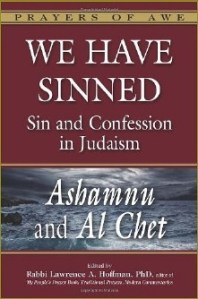
We Have Sinned:  Sin and Confession in Judaism, Edited by Rabbi Lawrence A. Hoffman, PhD.

We Have Sinned: Sin and Confession in Judaism

To figure this all out, I just edited a new book, We Have Sinned: Sin and Confession in Judaism (Jewish Lights Publishing). Here are some of the things I found out, things that make me take sin very very seriously — albeit with a modern twist.

To begin with, it is not just Christians who took sin seriously in antiquity; the Rabbis too believed that sin is part and parcel of human nature. If not “original,” sin is certainly “primal” in the rabbinic view. But sin is just a word, until we clothe it in telling metaphors; and Jews have used many metaphors to express what sin “exactly” is. The usual metaphor by which it is explained today, “missing the mark,” is hardly the best or even the most common. Sin is a whole lot more burdensome than that!

I use the word “burdensome” because for biblical Jews, sin was exactly that: a burden that weighs us down. God lifts the burden off our shoulders. I find that useful. Don’t we, today, still feel the burden of a guilty conscience? Don’t we too strive to relieve ourselves of the burden of guilt? On Yom Kippur we discover the healing presence of God who relieves us of whatever it is that weighs us down, preventing us from moving forward.

By rabbinic times, the favored metaphor became “sin as a debt.” The more we sin, the more we go into debt. “Punishment” in Hebrew is puranut, from the Hebrew root para, “to pay off what we owe.” The Lord’s Prayer of Jesus asks God to “forgive us our trespasses,” but also, in a more modern translation, “forgive us our debts.” Here too is a metaphor that works as well now as it did 2,000 years ago. Debt grows exponentially if we do not pay it back; so too, sin begets sin until lying, cheating, and faking our way through every passing day becomes the normal thing to do. Atonement for the moral debts we owe wipes the slate clean that we may start again.

Modern thinking denies credence to the word sin, because the nineteenth century taught us all what paragons of virtue we human beings can be. Reason and science demonstrated, we thought, that all things are possible. To be sure, the world wars of the twentieth century gave some of us pause in that regard; but all in all, our faith in human promise has remained. We still believe in the eventual victory of dignity, decency, and nobility.

Are we not, then, guilty of at least this one sin: neglecting the ongoing struggle for dignity, decency, and nobility. Hence the third metaphor for our time: t’shuvah, “turning.” as the realization that we have lost our way, are heading in the wrong direction, and must reverse our path. Look around! Whether we take our stand on the left or on the right, can any of us find much nobility in politics, advertising, business ethics, government, or anywhere else at all?

I have not let the twentieth century’s horrors erase my faith in human nobility. If all of us rise from Yom Kippur committed to furthering human dignity and rewarding the decency of those who feel similarly, I believe we can have it once again.

We Have Sinned: Sin and Confession in Judaism

We Have Sinned:  Sin and Confession in Judaism, Edited by Rabbi Lawrence A. Hoffman, PhD.

We Have Sinned: Sin and Confession in Judaism

All my life, I’ve wondered about the High-Holiday confessions in Judaism, and I finally edited a book about them. Called We Have Sinned, it just came out from Jewish Lights Publishing, and it represents a multitude of Jewish voices on the topics of sin, human nature, and repentance.

The book is a beginning of a conversation. I hope we can continue it here.

(We Have Sinned is available in print as well as various e-formats: Kindle [Amazon.com], Nook [B&N], and iBooks [Apple]; and also directly from Jewish Lights.)

To Thine Own Self Be True

One of Shakespeare’s greatest lines is the advice Polonius gives his nephew, in Hamlet. “To thine own self be true.” We like that: it resonates with our passion for personal authenticity, part and parcel, by now, of the way baby boomers (and now, their children) embrace the world. But it meant something different to Polonius than it does to us.

It was only in Shakespeare’s time, says Lionel Trilling, that society as we know it came into being. When Shakespeare had Polonius urge truth to oneself, he had in mind this new society of impersonal crowds, in which people largely went from role to role: innkeeper, consumer, employer, neighbor, and so forth. Authenticity for Polonius meant alignment with the self that lies below these social roles – a warning against pretending to be what we are not.

It was the age of Machiavelli, after all, who positively advised people to dissemble. The word “villain” came to mean precisely someone who never tells the truth – like Hamlet’s mother, of whom Hamlet says,

O most pernicious woman!
O villain, villain, smiling, damnèd villain!
…..
That one may smile, and smile, and be a villain.

Shakespeare specialized in such villains, not just Hamlet’s mother, but Iago who frames Othello and Cassius who manipulates Brutus to assassinate Julius Caesar. “To thine own self be true” meant avoiding pretense.

Because the sincerely authentic soul neither lies nor dissembles, the second half of Polonius’s advice ensues. Not just, “To thine own self be true” but also, “It must follow, as the night the day, Thou canst not then be false to any man.” It is this second half that we miss today. For us, the self exists for its own sake. As long as we develop our inner passions, it matters little if we then are false to others.

This was also a tenet enshrined in the popular understanding of Jean Paul Sartre’s existentialist novel Nausea that became practically a cult classic when the early boomers were going to College. Its protagonist is beset by an inexplicable fit of nausea until he admits that he is on his own in life — without history, tradition or God to justify or guide him. “Things are entirely what they appear to be and behind them there is nothing.”

How different this is from the religious mentality, where things are not just what they appear to be, and behind them there is something else: a set of ideals, values, and a commanding presence whom we call God.

The new authenticity of self has no moral force. It is purely expressive, a kind of romantic individualism allowing just about anything. Its compelling appeal is evident in the recruiting commercial of the US army from 1980 to 2001: not a call to defend the homeland, not a moral reminder to do one’s duty, but, “Be all that you can be: join the army.”

To be sure, other people too are said to have the right of self-expression, so we are not completely free to do whatever we want. But the best we get is the ultimate laissez faire: Express yourself however you like, as long as you don’t get in the way of others doing the same. John Stuart Mill is famous for his utilitarian ethic that advocated “the greatest happiness for the greatest number.” We have an expressive version of utilitarianism: “the greatest self-expression for the greatest number.”

Judaism, by contrast, measures expression of self by an external standard of human life at its best: something supremely good, worthy, purposeful – even noble, which calls us to service.

Gotthold Solomon was a founding rabbi of the New Israelite Temple of Hamburg. In 1824, he published a sermon entitled, “What is our Calling?” — a manifesto for a new kind of Judaism: a Judaism that celebrated the nobility of human potential. Almost 200 years later (despite the understandable nineteenth-century sexist reference to God), it sounds newly fresh with promise – exactly what self-expression for its own sake lacks.

“In spirit and soul, we belong to a higher order than what presents itself  as          ephemeral. We feel that we are human in the most noble sense of the                 word….         that we are closely connected to the Father of all existence, and that we could have no higher purpose than to show ourselves worthy of this relationship.”

The current culture of expressive individualism is dismally unaware of nobility as our highest human goal. Authenticity of self is valid, but only because the self’s deepest truth is its call to be noble.